

Turning the Process into the Product
Luxury travel agents were quoting, booking, invoicing, and managing clients across a patchwork of legacy tools. The opportunity was to build a travel agency in a box. One platform connecting financial systems, marketing, content, quoting, booking, and client management.
Role
Design Lead
Team
Product · Producers · Traffic Planners · Editors · Managers
Company
Global Technology and Retail Company
The Situation
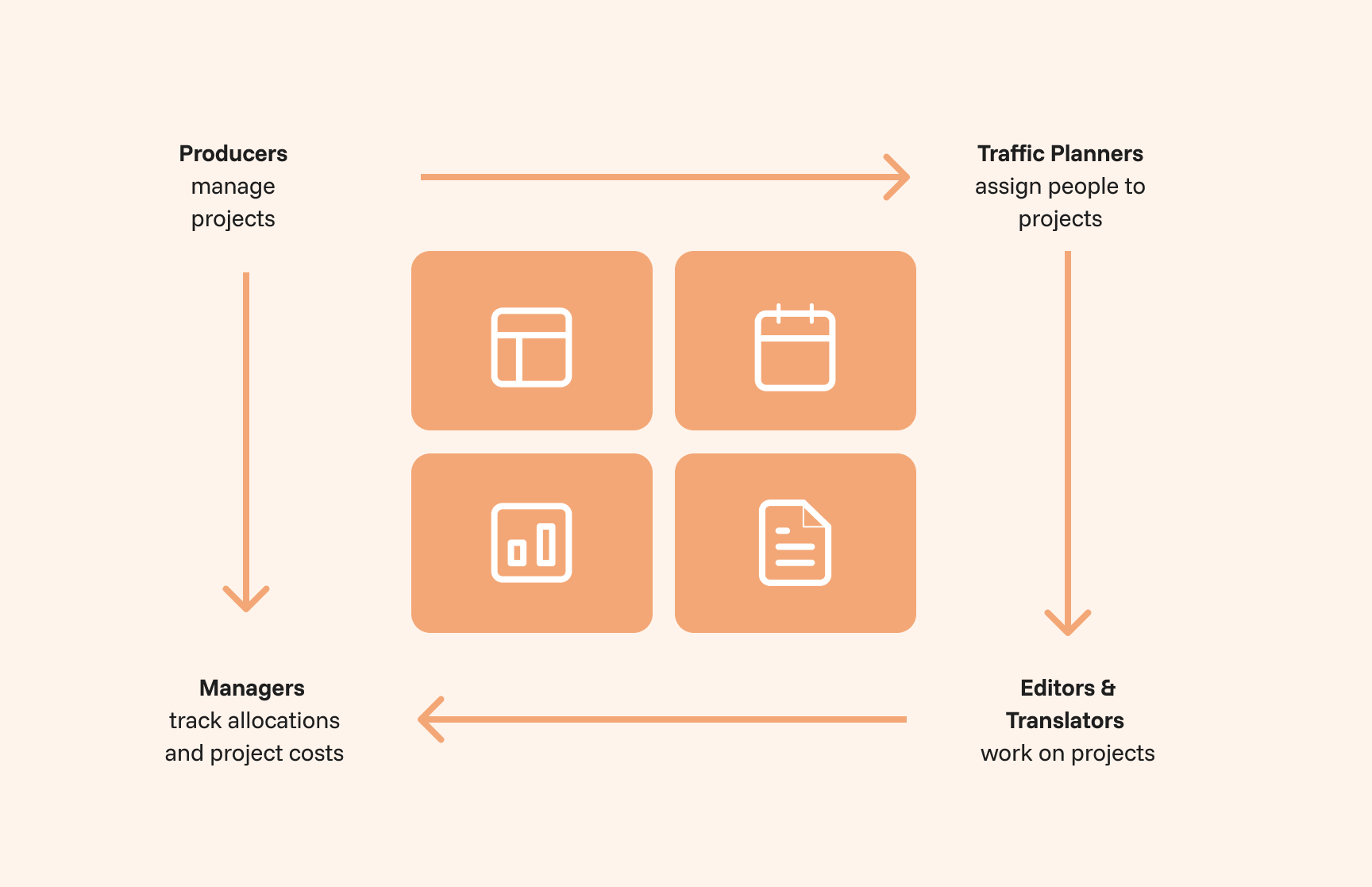
The work was global, fast-moving, and highly specialized. Producers managed complex projects. Traffic Planners assigned editors and translators across three offices. Managers tracked allocations and costs. Editors and translators did the work.
None of them had a shared system. Projects lived in a legacy tool. Staffing happened in local spreadsheets. Communication happened over email. With up to 30 editors per project, updated dozens of times a day across London, Singapore, and Silicon Valley, the coordination overhead was significant.
My Role
Design Lead. I owned design from research through visual direction and training materials across multiple releases. I also directed one Visual Designer through the delivery phases.
The Approach
Research surfaced the full scope of the coordination problem. Four distinct user types with distinct needs. One broken process holding them all together.
The hardest design problem was scheduling. Traffic Planners were assigning editors and translators around the world. Editors needed to see their deadlines in their local time. But final deadlines were understood in California time — the anchor that everyone ultimately worked backward from. Displaying time in a way that was locally legible and globally consistent required careful design. Show local time and editors know when to deliver. Show California time everywhere and you lose clarity for global teams. The solution had to do both without creating confusion.
Beyond scheduling, the work involved designing unified project management, staffing views, reporting, and the underlying information architecture that made four different user workflows coherent within one system.
What Shipped
A unified tool replacing the legacy system, spreadsheets, and email. Project management, scheduling, staffing, and reporting in one place. Delivered across multiple releases. Training materials included to support adoption across three global offices.
What Changed
- Unified project management, scheduling, staffing, and reporting in one system
- Scheduling approximately 3x faster anecdotally.
- Reduced manual coordination and spreadsheet churn across regions Improved real-time visibility and clarity of assignments for all four user types